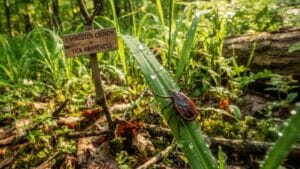
If you’ve spent any time outside in Livingston County, Michigan this year, you’ve probably heard the same thing from neighbors, friends, or local Facebook groups: there seem to be more ticks than ever before. Unfortunately, that isn’t just perception. Tick populations have expanded dramatically across Michigan over the past several years, and Livingston County is no exception.
With more wooded neighborhoods, expanding wildlife populations, and favorable weather conditions, homeowners throughout Howell, Brighton, Hartland, Pinckney, Fowlerville, Hamburg, Whitmore Lake, Green Oak, Genoa Township, and surrounding communities are seeing increased tick activity around their homes.
If you have children, pets, or simply enjoy spending time outdoors, understanding why tick numbers are rising—and how to protect your property—has never been more important.
Why Are There More Ticks in Livingston County?
Several factors are contributing to the rapid increase in tick populations throughout southeast Michigan.
1. Michigan’s Tick Population Continues to Expand
Health officials across Michigan have documented a significant expansion in blacklegged ticks (commonly called deer ticks), the primary carrier of Lyme disease. Areas that rarely experienced tick problems just a decade ago are now considered established tick habitats. Experts attribute this growth to favorable environmental conditions and the natural spread of tick populations throughout the Midwest.
2. More Wildlife Means More Ticks
Livingston County offers the perfect environment for ticks.
Large deer populations, abundant mice, squirrels, rabbits, raccoons, and other wildlife all help transport ticks throughout neighborhoods. Even if your yard is perfectly maintained, neighboring wooded lots and natural areas can continually introduce new ticks onto your property.
3. Warm, Humid Summers Help Ticks Thrive
Ticks prefer shaded, humid environments.
Wood lines, landscaping, ornamental shrubs, tall grass, leaf litter, and wooded edges provide ideal conditions for ticks to survive and reproduce. Michigan’s recent weather patterns have created excellent conditions for tick activity throughout much of the state.
Livingston County Is the Perfect Habitat
Livingston County combines everything ticks need:
- Mature wooded neighborhoods
- Large residential lots
- Lakes and wetlands
- Extensive hiking trails
- Deer travel corridors
- Dense landscaping
- High populations of wildlife
Communities including Brighton, Howell, Hartland, Pinckney, Hamburg Township, Green Oak Township, Genoa Township, Oceola Township, Tyrone Township, and Fowlerville all have neighborhoods where wooded property lines meet residential lawns. These transition areas are some of the highest-risk locations for tick activity.
Even homes located in subdivisions—not just rural properties—can experience heavy tick populations if nearby wildlife frequently travels through the area.
Lyme Disease Is Becoming More Common in Michigan
The growing tick population has led to a sharp increase in Lyme disease across the state.
Michigan has experienced a dramatic increase in reported Lyme disease cases over the past several years, leading the CDC to classify Michigan as a high-incidence Lyme disease state. State health officials say the rise is closely linked to expanding tick populations throughout Michigan.
Lyme disease is most commonly transmitted by infected blacklegged ticks. While not every tick carries disease, reducing tick exposure is the best way to reduce your family’s risk.
Where Are Ticks Hiding Around Your Home?
Many homeowners assume ticks only live deep in the woods.
In reality, they’re often just a few feet from your back door.
Common hiding spots include:
- Around home foundations
- Landscape mulch
- Flower beds
- Ornamental shrubs
- Tall grass
- Wood piles
- Stone retaining walls
- Fence lines
- Leaf piles
- Property edges
- Playground areas near trees
- Around sheds and detached garages
Ticks climb vegetation and wait for animals—or people—to brush against them.
Why DIY Tick Control Often Falls Short
Many homeowners try over-the-counter sprays with limited success.
The problem isn’t usually the product.
It’s coverage.
Ticks don’t spend much time in the middle of an open lawn. Instead, they hide where moisture, shade, and wildlife are present.
Professional treatments focus on:
- Home perimeter protection
- Landscape beds
- Shrub lines
- Wooded edges
- Fence lines
- Tick harborage areas
- Property perimeters
- Resting areas where ticks wait for hosts
Treating only the lawn often leaves the highest-risk areas untouched.
Protecting Your Family Starts at Home
If your family enjoys:
- Backyard barbecues
- Playing with children
- Gardening
- Walking pets
- Outdoor entertaining
- Fire pits
- Camping at home
- Yard games
Then reducing tick populations around your property should be part of your seasonal maintenance plan.
Professional property treatments create a protective barrier that targets ticks before they reach areas where your family spends time.
Combined with routine tick checks, keeping grass trimmed, and reducing leaf litter, property treatments provide another layer of protection.
Signs Your Property May Have a Tick Problem
You may want to consider professional tick control if:
- You’ve found ticks on pets.
- Family members frequently remove ticks after spending time outside.
- Deer regularly travel through your yard.
- Your property backs up to woods.
- You have heavy landscaping or natural areas.
- Children play near wooded edges.
- You enjoy spending evenings outdoors.
Many homeowners don’t realize they have a tick problem until someone is bitten.
Preventative treatments are often much easier than dealing with repeated tick encounters throughout the summer.
Tick Prevention Tips for Livingston County Homeowners
In addition to professional treatments, homeowners should:
- Wear EPA-approved insect repellent when spending time outdoors.
- Perform tick checks after outdoor activities.
- Check pets daily during tick season.
- Keep grass mowed regularly.
- Remove leaf litter and brush piles.
- Trim vegetation along walkways.
- Create separation between wooded areas and recreational spaces.
- Keep children’s play equipment away from wooded edges whenever possible.
State health officials continue to recommend these prevention measures as tick populations expand throughout Michigan.
Local Tick Control You Can Trust
As tick activity continues to rise throughout Livingston County, homeowners are becoming more proactive about protecting their families before problems develop.
At Tick Terminators, we specialize in professional tick and mosquito control for homes throughout Howell, Brighton, Hartland, Pinckney, Hamburg, Fowlerville, Whitmore Lake, Green Oak, Genoa Township, and surrounding southeast Michigan communities.
Our treatments focus on the areas where ticks actually live—not just the middle of your lawn—helping create a protective barrier around the places your family enjoys most.
If you’re ready to spend more time outside with greater peace of mind, contact Tick Terminators today for a fast online quote and discover why more Livingston County homeowners are choosing professional tick protection before tick season reaches its peak.